How School Infrastructure Investment Is Transforming African Communities
School infrastructure investment is the construction, improvement, and maintenance of learning spaces and the essential services that make them usable. Across African communities, investment in classrooms, water and sanitation, electricity, connectivity, and climate-resilient design can improve the conditions for learning while creating jobs and strengthening public services. The need is substantial: UNESCO estimates that 98 million children and young people in sub-Saharan Africa are out of school, while the World Bank and partners have reported that many children in low- and middle-income countries cannot read and understand a simple text by age 10. Evidence from programs such as Kenya’s school electrification expansion also shows how infrastructure can reach beyond classrooms, supporting local access to power and services. But results depend on equitable siting, reliable maintenance, and investment in teachers and learning materials alongside buildings.
School Infrastructure Investment: Meaning, Scope, and Community Effects
School infrastructure investment refers to funding and organizing the physical facilities, utilities, equipment, and upkeep needed for schools to operate safely and effectively. The World Bank’s education work treats school facilities as part of the enabling environment for learning, while UNESCO’s guidance on education facilities emphasizes that buildings should be safe, inclusive, healthy, and fit for local conditions. The term includes new construction, rehabilitation of existing schools, water and sanitation systems, power supply, digital infrastructure, and ongoing maintenance.
The relationship between infrastructure and educational outcomes is not automatic: a new classroom cannot substitute for trained teachers, relevant materials, or effective management. However, suitable facilities can remove barriers to attendance and participation. For example, a school with safe drinking water, separate and usable toilets, accessible routes, and adequate lighting is better positioned to serve girls, learners with disabilities, and children in remote communities. These investments also generate demand for local labor, materials, transport, and maintenance services, linking education spending to community economies.
Classrooms and basic facilities
Classroom investment covers construction, repair, ventilation, lighting, furniture, and measures to reduce overcrowding. A well-designed learning space is one that is structurally safe, appropriate for its climate, and large enough to support instruction without excessive crowding. UNESCO’s Institute for Statistics has documented major gaps in education financing and access across sub-Saharan Africa, where rapid population growth makes classroom capacity a continuing challenge. Expanding usable space can bring schools closer to growing settlements and reduce the pressure on existing facilities, although staffing and learning resources must grow with enrollment.
Water, sanitation, and hygiene
Water, sanitation, and hygiene (WASH) infrastructure means reliable water supply, usable toilets, handwashing facilities, drainage, and arrangements for safe cleaning and maintenance. The WHO and UNICEF Joint Monitoring Programme tracks these services in schools because inadequate facilities affect health, dignity, attendance, and the ability to manage menstruation. Its global reporting has found that many schools still lack basic drinking-water, sanitation, and hygiene services, with substantial disparities between countries and between rural and urban areas. In African communities, school WASH projects can also model safe practices and, where systems are designed for shared use, contribute to services that benefit nearby households.
Electricity and digital connectivity
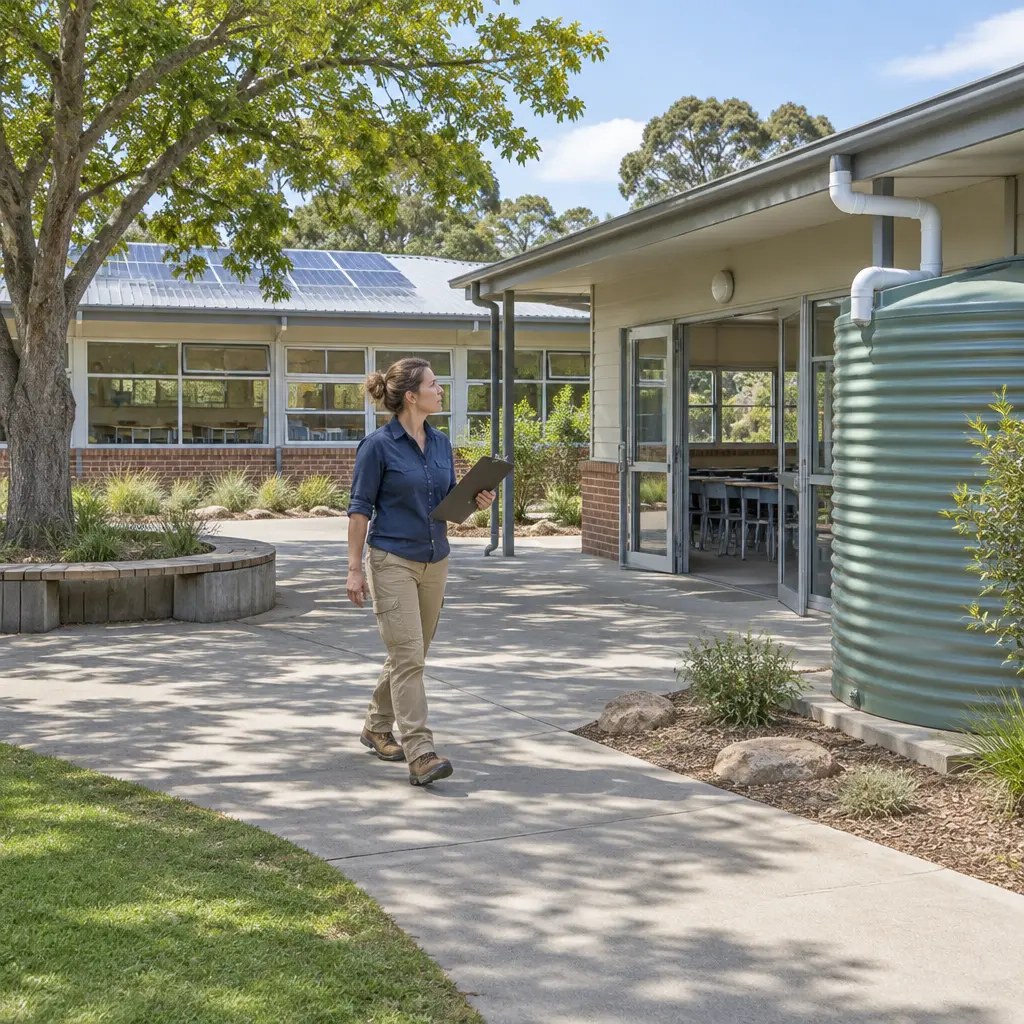
Electrification and connectivity include grid connections, mini-grids, solar power, charging systems, internet access, and the equipment and support needed to use them. Electricity can enable lighting, refrigeration for health or food services, and the operation of computers and communications equipment. The International Energy Agency has highlighted persistent electricity-access gaps in sub-Saharan Africa, particularly in rural areas. A school-based solar system may therefore support both teaching and community services, but its value depends on secure equipment, trained users, affordable connectivity, and a budget for repairs and replacement.
These core facilities make schools more accessible and functional. The next question is how investment choices can respond to local risk, social needs, and the wider economic role of a school.
Inclusive and Resilient School Infrastructure Investment
Inclusive and resilient school infrastructure is designed so that learners can use it safely and equitably, and so that facilities remain operational under local environmental and social pressures. UNICEF’s guidance on child-friendly schools and the World Bank’s work on resilient infrastructure both stress the importance of planning around users, hazards, and long-term operation—not simply completing construction. This approach includes accessible design, safe locations, climate adaptation, and community participation in decisions about siting and upkeep.
Gender-responsive and disability-inclusive facilities
Inclusive facilities are those that accommodate learners with different physical, sensory, and personal needs. Practical elements include ramps and accessible paths, appropriate classroom layouts, clear signage, well-maintained toilets, privacy, and menstrual health facilities. The Global Education Monitoring Report has repeatedly drawn attention to the way exclusion and unsafe conditions can undermine participation, particularly for girls and children with disabilities. Consultation with learners, caregivers, teachers, and disability organizations helps identify barriers that construction standards alone may miss.
Climate-resilient and disaster-aware design
Climate-resilient school design reduces exposure to hazards such as floods, heat, storms, drought, and landslides, while supporting continuity of education. Measures may include safer siting, improved drainage, heat-reducing roofs and ventilation, raised electrical equipment, water storage, and building materials suited to local conditions. UNICEF has warned that climate-related hazards disrupt education for millions of children worldwide each year. In parts of Africa facing recurrent floods or extreme heat, adapting school buildings can protect learners and public assets while allowing schools to serve as community information or emergency-support points when appropriate.
Local employment and community participation
Community-linked construction combines school investment with local procurement, skills development, and participation in project oversight. When feasible, hiring local workers and purchasing locally available materials can retain more spending within the area and build capacity for future repairs. Community involvement can also improve accountability by giving families and school committees a role in identifying priorities and monitoring progress. The benefit is not guaranteed: procurement must still meet safety and quality standards, and short-term construction jobs should not be confused with lasting employment unless maintenance and service roles are funded.
Evidence, Examples, and Conditions for Lasting Impact
School infrastructure produces the greatest community value when projects are planned as part of a broader education and public-service system. UNESCO, UNICEF, and the World Bank all emphasize that facilities need adequate financing, equitable access, and ongoing management. The evidence supports a measured conclusion: improved infrastructure can address practical barriers and create enabling conditions, but learning gains depend on how facilities are used and whether complementary services are available.
School electrification in Kenya
Kenya’s Last Mile Connectivity Project illustrates how investment in electricity access can connect public institutions and communities. The World Bank reports that the project expanded electricity connections, including to public facilities, as part of a national effort to extend power access. For schools, electricity can support lighting and digital learning, while the wider network can benefit nearby households and businesses. The example also shows why connection counts should be interpreted alongside reliability, affordability, equipment availability, and evidence of actual educational use.
School feeding and linked infrastructure in Ghana
Ghana’s school feeding program demonstrates how school services can connect education with local food systems. The World Food Programme describes school meals as a means of supporting nutrition and attendance, with procurement approaches that can create links to local agricultural producers. Such programs need suitable kitchens, safe water, food storage, and sanitation. This is an example of infrastructure functioning as part of a service package: buildings and utilities help make health, nutrition, and learning initiatives operational rather than delivering those outcomes on their own.
Maintenance, financing, and accountability
Maintenance is the planned inspection, repair, and replacement of building components and services over their useful life. Without it, roofs leak, toilets become unusable, solar systems fail, and newly built classrooms can deteriorate quickly. The World Bank’s public investment guidance stresses the importance of project preparation, lifecycle costs, procurement quality, and monitoring. Governments and partners can strengthen results by budgeting for operations and maintenance, publishing project information, using locally appropriate construction standards, and tracking whether facilities remain functional after handover.
Measuring outcomes beyond construction
A useful infrastructure assessment measures more than the number of buildings completed. Indicators can include classroom condition and crowding, access to safe water and usable sanitation, reliable electricity, accessibility, school attendance, time lost to facility breakdowns, and user feedback. Education outcomes—such as enrollment, retention, and learning—should be tracked alongside these service measures, while recognizing that many factors influence them. A chart comparing facility access by rural and urban location, gender, disability, and income could make unequal service provision visible and help direct future investment.
Conclusion: Infrastructure as a Foundation for Community Opportunity
School infrastructure investment in African communities includes classrooms and basic facilities, WASH, electricity and connectivity, inclusive design, climate resilience, and long-term maintenance. These investments can improve the conditions for learning, reduce practical barriers to participation, support local employment, and connect schools to wider community services. Kenya’s electrification experience and Ghana’s school feeding links illustrate the potential of integrated approaches, while evidence from international agencies underscores the need to measure service quality and equity—not just construction totals.
To make investment durable, governments, donors, school leaders, and communities should prioritize underserved areas, consult those who use facilities, fund maintenance from the outset, and evaluate whether infrastructure is functioning and improving access. Further reading from UNESCO, UNICEF, the World Bank, the WHO/UNICEF Joint Monitoring Programme, and the International Energy Agency can help decision-makers compare standards, financing approaches, and evidence.
Sources: UNESCO Institute for Statistics, Out-of-School Children and Youth, https://uis.unesco.org/en/topic/out-school-children-and-youth; World Bank, Ending Learning Poverty: What Will It Take?, https://www.worldbank.org/en/topic/education/brief/ending-learning-poverty; UNESCO, A Guide for Ensuring Inclusion and Equity in Education, https://unesdoc.unesco.org/ark:/48223/pf0000248254; WHO and UNICEF Joint Monitoring Programme, Progress on Drinking Water, Sanitation and Hygiene in Schools, https://washdata.org/reports/jmp-2022-wins; International Energy Agency, Africa Energy Outlook 2022, https://www.iea.org/reports/africa-energy-outlook-2022; Global Education Monitoring Report, 2020 Global Education Monitoring Report: Inclusion and Education, https://www.unesco.org/gem-report/en/2020inclusion; UNICEF, Learning Interrupted: Global Snapshot of Climate-Related School Disruptions in 2024, https://www.unicef.org/reports/learning-interrupted-global-snapshot-climate-related-school-disruptions-2024; World Bank, Kenya Electricity Modernization Project and Last Mile Connectivity Project, https://projects.worldbank.org/en/projects-operations/project-detail/P120014; World Food Programme, Ghana School Feeding Programme, https://www.wfp.org/countries/ghana; World Bank, Public Investment Management Reference Guide, https://openknowledge.worldbank.org/handle/10986/33368.