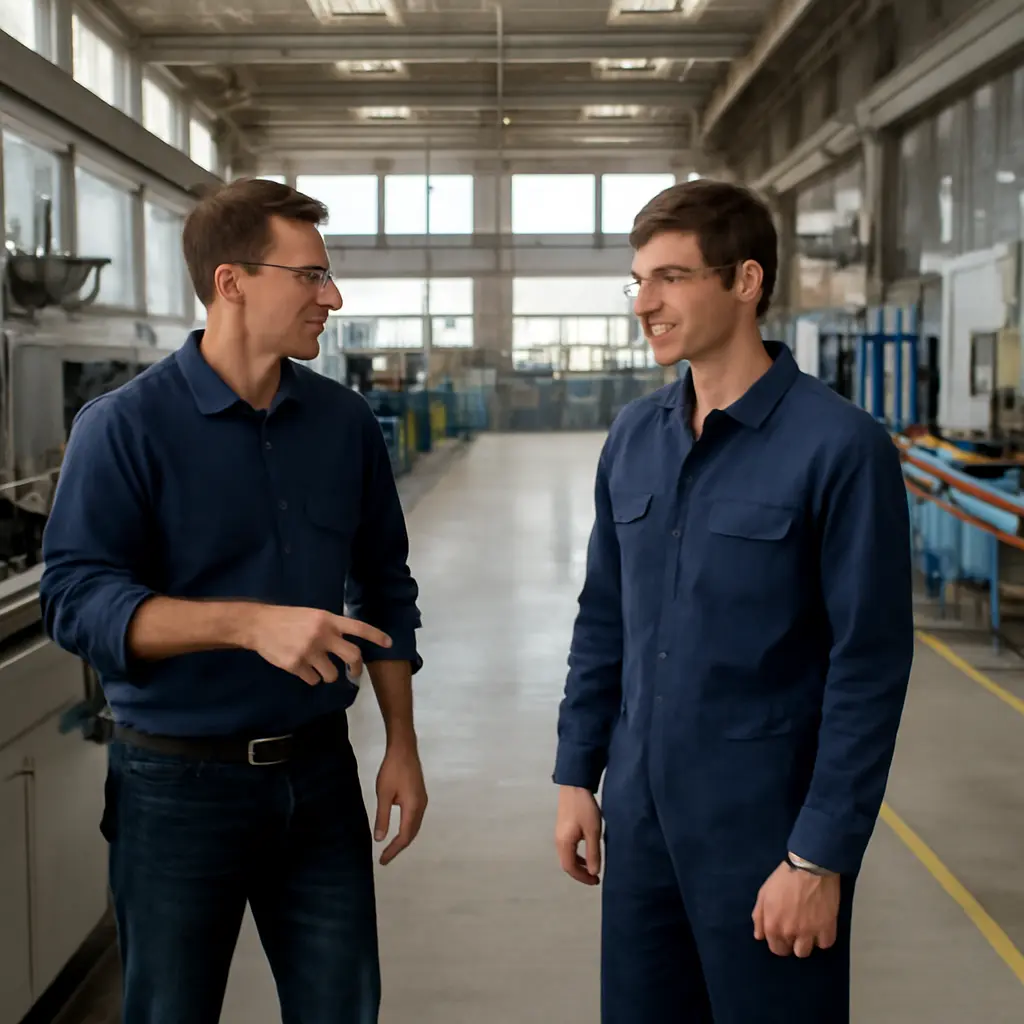
Formal Apprenticeships Compared with Informal Training on Factory Floors
Formal apprenticeships and informal factory-floor training are two ways workers learn job skills, but they differ in structure, recognition, and oversight. A formal apprenticeship combines paid work with planned instruction and supervised on-the-job learning; informal training typically develops through demonstration, coaching, observation, and practice during production. The distinction matters as manufacturers face persistent skills gaps: the U.S. National Association of Manufacturers and Deloitte projected in 2024 that 1.9 million manufacturing jobs could go unfilled by 2033 if workforce challenges are not addressed. Comparing the models shows how apprenticeships establish measurable competencies, how informal learning transfers practical know-how, and why many factories benefit from combining them.
Formal Apprenticeships Define Structured Factory Training
A registered apprenticeship is a paid, structured training program that combines supervised on-the-job learning with related technical instruction and culminates in a recognized credential. The U.S. Department of Labor describes registered apprenticeships through five core elements: paid work, structured on-the-job learning, classroom or related instruction, progressive wage increases, and a nationally recognized credential. In factories, these programs commonly prepare workers for occupations such as industrial maintenance technician, machinist, tool-and-die maker, and mechatronics technician.
The model makes learning explicit: employers identify competencies, allocate training time, and assess progress rather than relying solely on whether a worker appears ready to perform a task. Department of Labor guidance generally describes apprenticeships as lasting one to six years, depending on the occupation and program design. That range is not a guarantee for every trade, but it illustrates the long-term investment often required for complex technical roles.
Standards, instruction, and credentials
Apprenticeship standards specify the occupation, learning requirements, supervision, and assessment expected of participants. Related technical instruction can cover subjects such as blueprint reading, electrical systems, industrial safety, mathematics, and programmable logic controllers. A credential documents that the apprentice met the program’s requirements, making skills more legible to future employers than experience described only in general terms.
The National Apprenticeship Act of 1937 established a federal framework for promoting apprenticeship standards and protecting apprentices. Today, programs may be registered with the U.S. Department of Labor or a federally recognized State Apprenticeship Agency. Registration does not mean every program uses the same curriculum: standards are occupation- and sponsor-specific, and employers can adapt training to local equipment and production needs while meeting applicable requirements.
Progressive wages and measurable progression
Progressive wage increases tie compensation to advancement through the program’s skill milestones. The U.S. Department of Labor’s 2023 evaluation of the American Apprenticeship Initiative reported that participating employers valued apprenticeships as a way to build a skilled workforce, while apprentices gained paid experience and occupational training. Such findings support the model’s workforce-development rationale, although results vary across industries, employers, and program designs.
A wage schedule also gives factories a framework for balancing training costs with growing productivity. An apprentice may begin with basic tasks under close supervision and advance toward diagnosing faults, setting up equipment, or completing maintenance work with greater independence. For safe implementation, progression should reflect demonstrated competency—not merely time served.
Informal Training Transfers Factory-Floor Knowledge
Informal factory-floor training is skill development that occurs through everyday work rather than a formally registered program or fully specified curriculum. Workers learn by observing experienced colleagues, receiving demonstrations and feedback, asking questions, troubleshooting equipment, and repeating tasks. It can be intentional, such as a supervisor showing a new hire how to change a tool, or incidental, such as learning a production shortcut while working alongside a veteran operator.
This form of learning is especially useful for knowledge that is difficult to capture in a manual: the sound that signals a machine is out of alignment, the feel of a correctly seated component, or the practical sequence for responding to a recurring stoppage. Its flexibility is also its weakness. Without clear standards and records, workers may receive inconsistent instruction, miss foundational concepts, or learn unsafe habits.
Demonstration, shadowing, and peer coaching
Demonstration and shadowing allow a novice to watch an experienced worker perform a task, then practice under observation. Peer coaching adds ongoing questions, corrections, and troubleshooting. These methods can transfer tacit knowledge quickly because instruction occurs beside the actual machine, materials, and work conditions.
The U.S. Occupational Safety and Health Administration emphasizes that workers need training to recognize hazards and understand safe work procedures. A demonstration alone is not sufficient if it omits hazard controls, emergency steps, or a check that the learner can perform the task correctly. Factories can strengthen informal coaching with task checklists, documented sign-offs, and periodic reassessment.
Learning by doing and production problem-solving
Learning by doing develops competence through supervised practice on real tasks. It is particularly valuable for responding to variation: a line changeover, an unusual defect, or a machine fault may require judgment beyond a standard work instruction. However, practice without structured feedback can reinforce errors, and production pressure may lead trainers to prioritize speed over complete learning.
The National Institute for Occupational Safety and Health’s hierarchy of controls places eliminating hazards and engineering controls above reliance on training alone. This principle is relevant to informal instruction: coaching should support safe systems of work, not substitute for guarding, lockout/tagout procedures, or other required controls. Training is most reliable when workers are given time to learn without being exposed to preventable risks.
Apprenticeships and Informal Training Differ in Accountability
Both approaches use work experience, supervision, and practice, but they answer different questions. A formal apprenticeship asks whether a worker has completed defined training and demonstrated occupational competencies. Informal training asks whether a worker can learn and perform a specific task in the local workplace. The approaches are complementary rather than mutually exclusive.
Comparison of structure and outcomes
- Curriculum: Apprenticeships follow documented standards; informal training may rely on local procedures and the trainer’s experience.
- Assessment: Apprenticeships usually track milestones and competency; informal learning may be judged through observation without a consistent record.
- Recognition: Apprenticeships can lead to an industry-recognized credential; informal training typically produces workplace-specific experience.
- Adaptability: Informal coaching can respond immediately to a machine, product, or shift-specific need; apprenticeship programs provide a broader planned learning pathway.
- Continuity: Written standards can preserve knowledge when employees leave; informal knowledge is more vulnerable to turnover unless it is documented and passed on.
A factory relying only on informal training may onboard workers quickly but struggle to verify what each person has learned. A factory relying only on formal instruction may provide robust foundations yet fail to capture the practical adjustments needed on a particular line. Combining the two connects occupational breadth with immediate workplace relevance.
Costs, retention, and workforce planning
Apprenticeships require coordination among employers, instructors, and program administrators, and trainees need paid time to learn. Informal training may appear less costly because it uses existing staff and production settings, but that calculation can overlook mentor time, inconsistent output, rework, safety incidents, and the cost of replacing workers who leave.
The U.S. Department of Labor’s 2023 apprenticeship evaluation documented employer-reported benefits that included improved recruitment and development of a skilled workforce. Those findings are useful evidence of potential value, not a universal return-on-investment estimate for every factory. Employers should measure their own outcomes, such as completion rates, time to competency, quality defects, retention, and safety performance.
A Hybrid Factory Training Model Connects Credentials with Practice
A hybrid model uses apprenticeship structure for core occupational competencies and informal coaching for site-specific knowledge. For example, an industrial maintenance apprentice might receive instruction in electrical theory and troubleshooting through a formal curriculum, then learn the plant’s particular equipment, escalation procedures, and maintenance history from experienced technicians.
Designing a practical learning pathway
- Identify hard-to-fill roles and the competencies required for safe, independent work.
- Use applicable apprenticeship standards or develop a documented competency map tied to the occupation.
- Assign trained mentors and protect time for instruction, observation, and supervised practice.
- Record task demonstrations, safety qualifications, and competency checks in a consistent system.
- Review outcomes regularly, including productivity, quality, retention, completion, and injury or near-miss data.
For example, a machining apprentice could learn measurement, materials, and machine fundamentals through planned instruction while shadowing an experienced operator during changeovers. A checklist can establish required safety and setup steps; mentor feedback can address machine-specific judgment; and a practical assessment can confirm that the apprentice can perform the process consistently. This example illustrates a design approach, not a reported case study.
Employer and worker measures of success
Evaluation should track more than enrollment. Useful indicators include program completion, time to independent performance, wage progression, quality and scrap rates, employee retention, and whether training covers required safety procedures. Comparing these measures before and after implementation can help employers determine whether the program is improving workforce readiness and where instruction needs revision.
The 2024 NAM–Deloitte projection of up to 1.9 million potentially unfilled manufacturing jobs by 2033 underscores why workforce development deserves attention, but it is a forecast, not a count of vacancies already present. Factories should interpret it as a warning about projected demand and skills challenges, then use local labor-market information and their own staffing data to set priorities.
Conclusion: Combine Structured Apprenticeships with Informal Factory Learning
Formal apprenticeships provide planned instruction, competency milestones, progressive wages, and credentials; informal training transfers practical, site-specific knowledge through demonstration, coaching, and supervised work. Each has limitations when used alone: formal programs can be less responsive to local routines, while unstructured learning can be inconsistent and difficult to verify. A hybrid approach links recognized occupational skills with the hands-on judgment needed on a factory floor.
Manufacturers can act by identifying priority occupations, reviewing registered apprenticeship options, training mentors, documenting task competencies, and measuring outcomes over time. Workers, employers, and educators can also consult the U.S. Department of Labor’s apprenticeship resources and OSHA guidance when developing programs. The broader goal is not simply to fill jobs, but to build a safer, more adaptable workforce with skills that workers can demonstrate and carry forward.
Sources: U.S. Department of Labor, Apprenticeship: A Workforce Strategy for Employers, https://www.apprenticeship.gov/employers; U.S. Department of Labor, American Apprenticeship Initiative Evaluation, https://www.dol.gov/agencies/eta/research/publications/american-apprenticeship-initiative-evaluation; National Association of Manufacturers and Deloitte, 2024 Manufacturing Industry Outlook, https://www.nam.org/2024-manufacturing-industry-outlook-30141/; Occupational Safety and Health Administration, Training Requirements in OSHA Standards, https://www.osha.gov/training; National Institute for Occupational Safety and Health, Hierarchy of Controls, https://www.cdc.gov/niosh/hierarchy-of-controls/about/